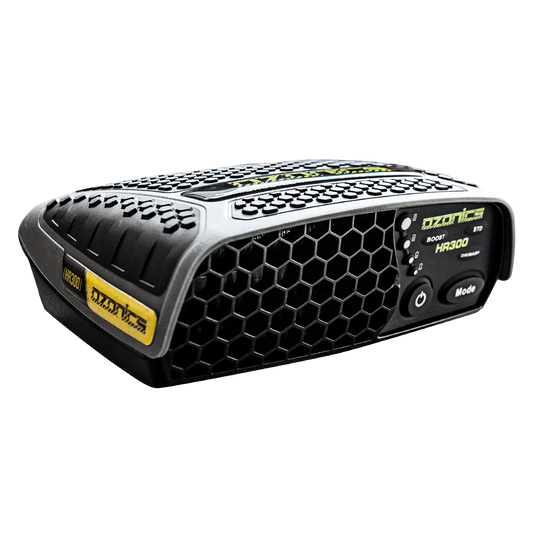
Two hunters, two odor sources
The question sounds simple: if two people hunt together, can they share one Ozonics? Cole's answer on Episode 120 is usually no. He recommends one field unit per hunter. The reason is not just that two people produce more odor; it is that they may produce two separate streams of odor moving through the air.
Think about two streams of smoke
Cole uses a smoke-bomb comparison. Imagine two hunters in different positions, each holding a smoke source. Even when the same wind moves past both, the smoke may travel in separate streams. The hosts use that picture to explain why a single unit positioned for one hunter may not be aligned with the odor coming from the other.
What about a two-person ladder stand?
The podcast raises one narrow exception: hunters sitting shoulder to shoulder in a ladder stand, with a crosswind that carries air across both of them in the same direction. Cole says that setup might be a situation where one unit could make sense. He does not present it as a guarantee or a universal setup rule.
Positioning matters more than simply turning it on
The episode emphasizes placing the unit near the odor source and directing its output downwind. That recommendation is part of the hosts' practical setup approach. Always follow the model-specific mounting, clearance, and safety instructions rather than assuming the same placement works in every stand.
The takeaway
For most paired hunts, the hosts' rule of thumb is straightforward: plan on a unit for each hunter. The real objective is to account for where each person's odor travels, not merely how many people are sitting in the stand.
Frequently asked questions
Can one unit cover two hunters in separate stands?
The hosts recommend one unit for each hunter rather than trying to cover two separated odor sources.
What if we sit shoulder to shoulder?
The podcast mentions a possible crosswind exception, but does not promise that one unit will be sufficient.
Does a more powerful unit automatically cover two people?
Not necessarily. The hosts emphasize separate airflow paths as well as output.
Source episode: Killerwinds Podcast, Episode 120 — Rapid-Fire Ozonics Q&A (August 2025).
Listen to the Full Conversation
This article was developed from a discussion on the Killerwinds Podcast, where the Ozonics team explores scent management, ozone technology, and the practical application of Ozonics in the field. Watch or listen to the full conversation for a deeper understanding of the technology, its intended use, and the experiences behind it.