Northwest on the forecast. Southeast in the tree.
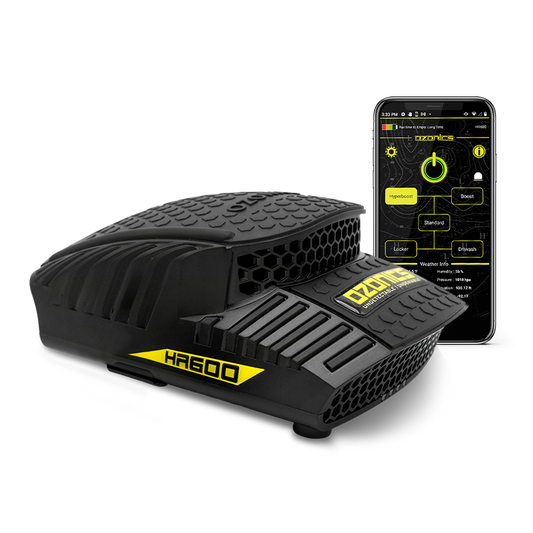
We climbed into a familiar stand we call Co-op expecting a north-northwest wind. The property has steep little cuts, ravines, and hills. At times the wind behaved exactly as forecast. Then it swung the opposite direction. During one sit, we watched it move back and forth enough that we repeatedly adjusted our Ozonics positioning.
Why light winds get complicated
Our experience at this location is that when the prevailing wind is light—around zero to five or six miles per hour in the conditions we described—local thermal movement can become more noticeable. Cooler air may drain downhill, while warming slopes can change airflow after sunrise. The exact pattern depends on the terrain and weather; those numbers are observations from this property, not a universal threshold.
The button bucks that appeared out of nowhere
After a quiet morning, two young button bucks bounded into view and closed to about thirty yards. They seemed uneasy, lifted their noses, and looked around. As the wind shifted, they moved to circle toward what had become the downwind side. Eventually they reached the other side of a property fence, where there was no legal shot available to us, and moved away.
What the encounter can—and cannot—prove
We interpreted their behavior as a response to changing airflow and odor, but the encounter alone cannot establish exactly what the deer smelled. It also is not a controlled test of scent-control equipment. The practical lesson is clearer: wind direction can change rapidly at a single stand, and deer may approach or circle in ways that create unexpected downwind exposure.
What to do before the next sit
Learn the tendencies of individual stands, especially where ravines and slopes converge. Monitor actual airflow rather than trusting the forecast alone. Think through where deer may end up if they circle, and make sure the route and shooting opportunity remain on land you can legally hunt. Have a backup stand when conditions are unmanageable.
The takeaway
The Co-op encounter reinforced that a good wind forecast does not guarantee a stable wind in the tree. Terrain and thermals matter, and sometimes the best decision is to adapt or leave.
Frequently asked questions
Why does wind reverse in a ravine? Local terrain and temperature-driven air movement can interact with the prevailing wind, particularly in lighter conditions.
Does Ozonics mean I can ignore wind direction? No. The hosts still emphasize stand choice, airflow monitoring, and proper downwind positioning.
Listen to the Full Conversation
This article was developed from a discussion on the Killerwinds Podcast, where the Ozonics team explores wind direction, thermal movement, and how changing conditions influence hunting decisions. Watch or listen to the full conversation for additional field observations and insights into understanding wind and thermals while hunting.
Watch the Full Killerwinds Podcast Episode